
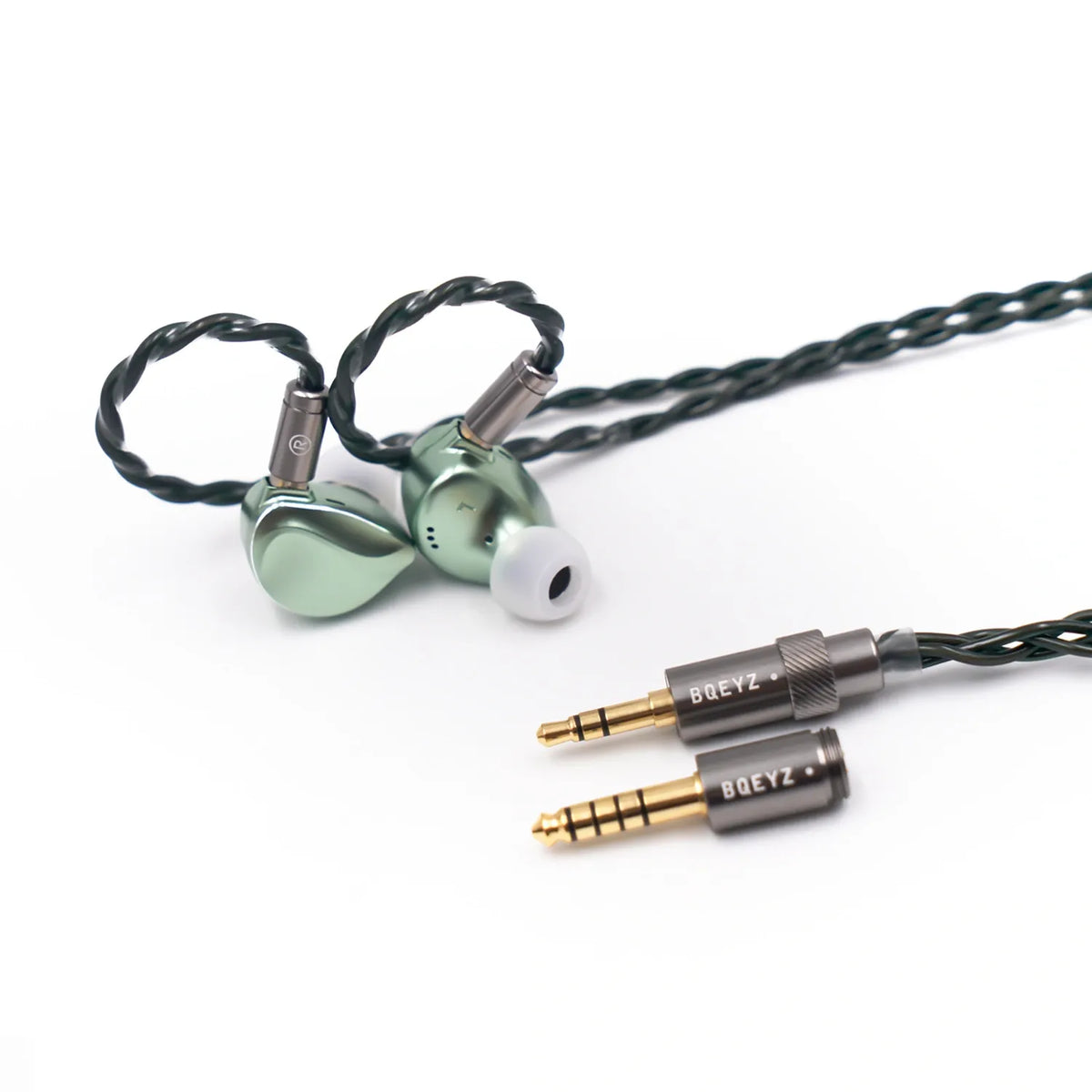
Short answer: a bone conduction IEM is a wired in-ear monitor that adds a bone conduction driver to a normal dynamic driver. The dynamic driver plays sound through the air in your ear canal, while the bone conduction driver sends fine vibrations through the shell to your ear. Together they give more texture, separation and a wider soundstage than a single driver.
If you've spent any time browsing in-ear monitor (IEM) forums lately, you've probably seen the term "bone conduction" attached to earphones that still look like regular wired IEMs — not the open-ear sport headphones the term usually brings to mind. That's a different, newer technology, and it's changing what a "complete" sound signature can mean in a single earpiece.
Here's what bone conduction actually does inside an IEM, why it matters, and how to figure out if it's right for your ears.
Bone Conduction Isn't New — Using It Inside an IEM Is
Bone conduction technology has existed for years in swim headphones and open-ear sport earbuds, where a transducer rests against your cheekbone or temple and sends vibrations through bone straight to your inner ear, skipping the eardrum entirely.
What's newer is combining that same principle with a traditional dynamic driver inside a sealed IEM shell. Instead of replacing the eardrum-based listening experience, the bone conduction unit works alongside a conventional driver — one handles the vibration-based frequencies, the other handles standard air-conducted sound. The result is a hybrid signal your ear perceives as a single, unified sound.
How a Bone Conduction Driver Works Inside an IEM
A bone conduction unit sits inside the shell, close to where the earphone touches your ear. Depending on the design it can be a piezoelectric (PZT) ceramic element or a coil-driven unit (the BQEYZ Wind, for example, uses a 10mm coil bone-conduction driver, while the new BQEYZ Vesper uses a direct-drive PZT driver). When an audio signal passes through it, it vibrates at very high speed, and those vibrations transfer through the shell to your ear.
Paired with a dynamic driver for the rest of the frequency range, this setup can do a few things a single dynamic driver alone struggles with:
- Add texture and depth to the music, so you don't just hear it, you feel it
- Add a distinct sense of separation and "3D" spatial layering, since two different physical mechanisms are producing sound simultaneously
- Keep mids and highs clear instead of being masked by bass, since the workload is split across two driver types
What Does It Actually Sound Like?
This is the part specs can't fully explain, and it's also the most debated part of bone conduction IEMs online. Reviewers of BQEYZ's Winter series and Wind consistently describe a few recurring traits:
- A wider, more holographic soundstage than typical single-DD or hybrid IEMs at a similar price
- Noticeably tighter, more textured bass rather than bloated or boomy low end
- A sense of note separation that makes busy mixes feel less congested
Some listeners also report a very slight "edge" or metallic quality on certain tracks at first listen — something that's tuning- and tip-dependent, and often smooths out with the right eartip seal (eartip choice makes a bigger difference on bone conduction IEMs than on conventional ones, since seal quality affects how vibration transfers to your ear).
Bone Conduction vs. Standard Dynamic Driver IEMs
| Standard Dynamic Driver | Bone Conduction Hybrid | |
|---|---|---|
| Sound delivery | Air conduction through eardrum | Air conduction + bone vibration |
| Bass character | Driver-size dependent | Often tighter, more textured |
| Soundstage | Standard | Wider, more layered |
| Fit sensitivity | Moderate | Higher — seal quality matters more |
| Best for | General listening | Listeners chasing space, separation and texture |
Neither is objectively "better" — it's a different mechanism that changes how certain frequencies reach your ear, and different tunings will suit different music genres and listener preferences. Learn more about mixed-driver designs in Hybrid IEM vs Dynamic IEM.
Which BQEYZ IEM Should You Try First?
If bone conduction has your curiosity, here's how BQEYZ's current lineup breaks down (or compare them all in our Bone Conduction IEMs collection):
- Vesper — our newest model: a 10.8mm dual-cavity dynamic driver with a 4μm ultra-thin diaphragm plus a direct-drive PZT bone conduction driver, for sweet, warm vocals and extra high-frequency detail.
- Winter2 — the current-generation bone conduction flagship, with a 12mm dual-cavity dynamic driver and an 11.6mm mid-high frequency driver, refined for a smoother, more natural top end.
- Winter Ultra — a dual-cavity dynamic driver with a PAR diaphragm plus a high-frequency bone conduction driver, for high-resolution, monitor-like detail. It rewards experimenting with eartips for the best coupling.
- Wind — a 10mm dynamic driver plus a 10mm bone conduction driver, tuned for natural vocals and a wide soundstage.
If you're new to the technology, start by reading real-world impressions in our BQEYZ review blog, with listener reviews across the whole lineup, including Winter2, Winter Ultra, Frost, Wind and BQ10.
Getting the Best Results From a Bone Conduction IEM
A few quick tips if you pick one up:
- Try multiple eartip sizes and materials before judging the tuning — seal directly affects bone conduction coupling.
- Give it 20–30 hours of listening before forming a final opinion; many listeners report the "edge" some reviews mention softens with wear and tip adjustment.
- A/B against a standard dynamic driver IEM you already know well — the soundstage and texture differences are usually more obvious in direct comparison than in isolation.
Bone Conduction IEM FAQ
Do bone conduction drivers in IEMs actually work?
Yes. The bone conduction driver does not replace the dynamic driver; it adds vibration-based detail on top of it. Listeners most often notice tighter bass, better separation and a wider soundstage.
Is a bone conduction IEM the same as bone conduction headphones?
No. Open-ear bone conduction headphones sit on your cheekbones and leave the ear canal open. A bone conduction IEM sits in your ear like a normal IEM, so you keep noise isolation and full bass.
Can other people hear my music from a bone conduction IEM?
It works like a normal sealed IEM, so very little sound leaks out at normal volume.
What is the best bone conduction IEM to start with?
For natural vocals and a wide soundstage, start with the Wind. For extra high-frequency detail, try the Vesper. For our flagship tuning, choose the Winter2.
Have questions about which BQEYZ model fits your listening style? Contact us — we're happy to help you find the right fit.
Share:
Ultimate Guide: Best Wired Earphones for Music, Running, Gaming & Budget Audiophiles
Bone Conduction IEM: Meet the BQEYZ Vesper